
Ball Valves
HIPPS Service Ball Valve
Fast-acting, SIL-capable trunnion ball valve for High Integrity Pressure Protection Systems that isolate upstream pressure in seconds.
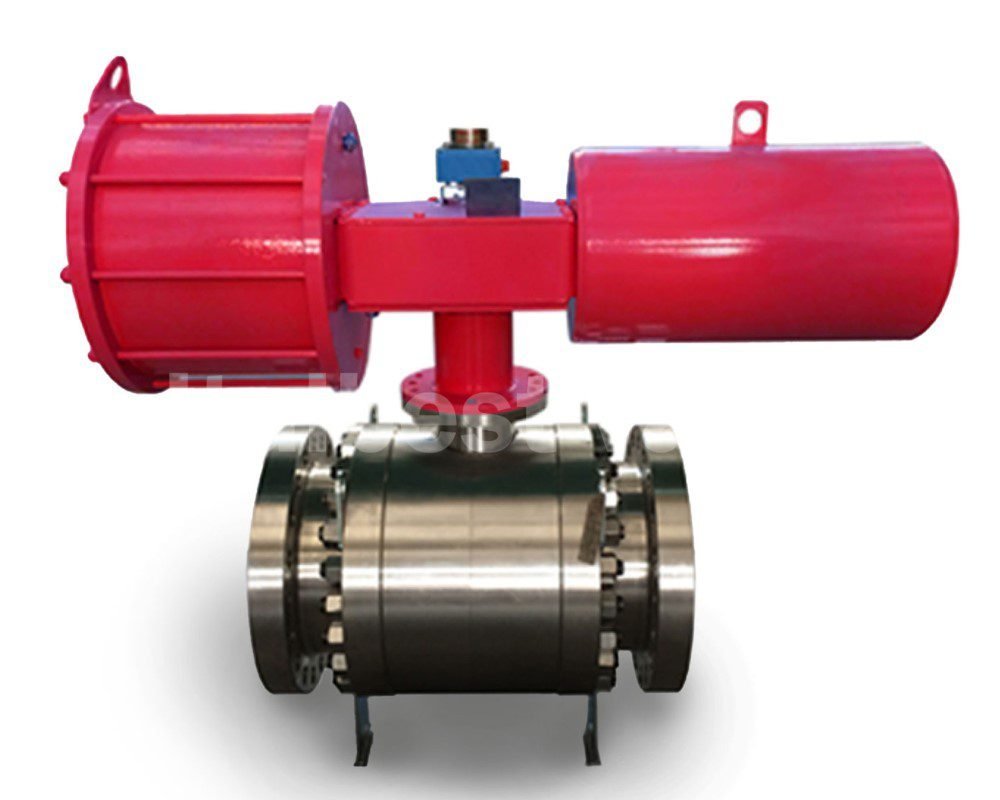
Overview
HIPPS service ball valves are crucial components within High Integrity Pressure Protection Systems (HIPPS) designed for critical safety applications. In summary, HIPPS ball valves play a crucial role in protecting process systems from overpressure conditions by providing rapid and reliable shut-off capabilities. Their fail-safe design, sealing performance, and robust construction make them essential components in high-integrity pressure protection systems across various industrial applications.
Key features
- High Integrity Pressure Protection System (HIPPS): A HIPPS is designed to prevent overpressure scenarios that could lead to equipment damage, environmental hazards, or personnel safety risks. It typically consists of sensors, logic solvers, and final elements (valves) working together to ensure that the pressure in a system remains within safe limits.
- Ball Valve Configuration: The valve element in a HIPPS system is often a ball valve due to its quick-acting and reliable shut-off capabilities. Ball valves can achieve tight shutoff by rotating a spherical disc (ball) within the valve body, which aligns with the flow path to stop or allow fluid flow.
- Safety and Reliability: HIPPS ball valves are selected for their ability to provide rapid closure in response to signals from the pressure sensors or logic solver. This ensures that the system reacts swiftly to prevent overpressure situations, protecting downstream equipment and personnel.
- Fail-Safe Design: In a HIPPS configuration, ball valves are often designed as fail-safe. This means that they default to a safe position (typically closed) in the event of a failure in the control system or loss of power. This feature enhances the reliability of the protection system.
- Sealing Performance: Ball valves used in HIPPS applications are engineered to provide bubble-tight sealing. This minimizes the risk of leakage, ensuring that the valve can effectively isolate the process fluid to maintain system integrity during normal operation and in emergency shutdown scenarios.
- Materials and Construction: HIPPS ball valves are typically constructed from materials such as stainless steel, carbon steel, or special alloys, depending on the process fluid, temperature, and pressure requirements. These materials offer corrosion resistance and durability necessary for demanding industrial environments.
- Compliance and Standards: HIPPS systems and components, including ball valves, are designed and manufactured to comply with international standards and regulations governing process safety and functional safety (e.g., IEC 61508, IEC 61511).
- Applications: HIPPS ball valves are commonly used in industries such as oil and gas production, refining, chemical processing, power generation, and pipelines where safeguarding against overpressure is critical for operational safety and regulatory compliance.
Technical specifications
- Size Range
- 1/2 – 24 NPS, DN15 - DN600
- Body Materials
- ASTM A216, A105, A350, A182, A351, A352, A890, A995.
- Temperature Range
- -29°C to 450°C
- Plug Materials
- ASTM A216, A105, A350, A182, A351, A352, A890, A995.
- Maximum Allowable Operating Pressure
- ANSI 150#, ANSI 300#, ANSI 600# , ANSI 900#, ANSI 1500#, ANSI 2500#
- Seat Materials
- PTFE, NYLON, PEEK, NBR, KELF, ENP (Electroless nickel plating), HC (Hard chrome).
- Shutoff Rating
- Bidirectional Bubble-tight
- Body Style
- Flanged End, Butt Weld, FE V/s BW
- Design Standard
- API 6D, ASME 16.34
- Flange Drilling
- ASME B16.5
- Testing Standard
- API 598, ISO 5208, EN 12266-1
- Face To Face
- ASME B16.10
- Applications
- Oil & Gas, Process, Power Generation, Petrochemicals
Applications
- Oil & Gas
- Process
- Power Generation
- Petrochemicals
Frequently asked questions
Application engineering
Specify your requirement.
Share your process conditions, required configuration and quantity. Our team will confirm suitable options and available documentation.
Thank you — enquiry received
An application engineer will review your requirement and reply within one working day.